
Oncology
Oncology Overview
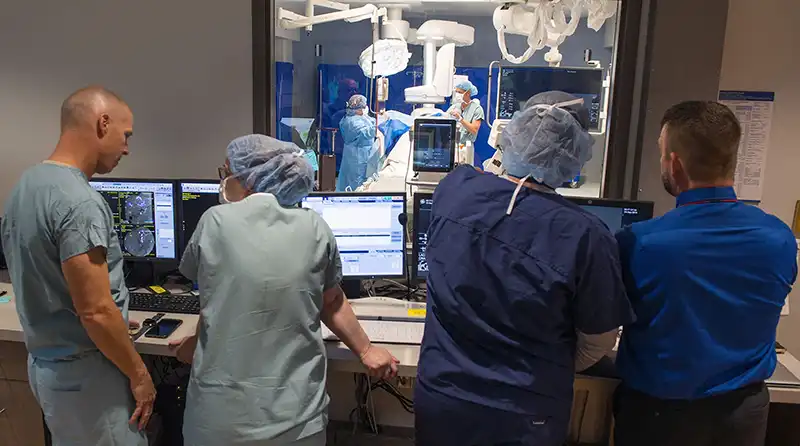
Inland Imaging’s Interventional Radiology team offers several minimally invasive, image-guided oncology treatments designed to target cancer cells while minimizing impact on the rest of the body. These include thermal ablation techniques such as radiofrequency ablation, microwave ablation, and cryotherapy, as well as liver-targeted therapies like radioembolization (Y-90) and chemoembolization (TACE).
The team also provides theranostics and LUTATHERA, an intravenous radiopharmaceutical therapy for specific cancer types that is now available locally to patients in the Inland Northwest through Inland Imaging’s Nuclear Medicine and Interventional Radiology departments.
Frequently Asked Questions
What is thermal ablation?
Thermal ablation is a generic term for a hot or cold treatment for disease in tissue, bone, or organs. It may also be known by a specific name: Radiofrequency ablation (heat), Microwave ablation (heat), or Cryotherapy (cold). It is a minimally invasive treatment for cancer and other tumors. It is an imageguided technique that uses extreme heat or freezing temperature to destroy cancer cells. The procedure is performed by an Interventional radiologist, who is a physician that specializes in this type of treatment.
With thermal ablation, the physician uses CT, MRI, or US to see the tumor, and then places a needle electrode through the skin, into the tumor. High-frequency electrical currents, microwave currents or gases are passed through the electrode, creating a burn or an ice ball that destroys the abnormal cells.
What are common uses of thermal ablation?
Burning or freezing is often used to treat many types of cancer, in several different organs, including in the liver, lung, kidney, and bone.
In general, thermal ablation is most effective in treating tumors that are less than three centimeters in diameter. There are some exceptions to this rule that may lead your physician to recommend the treatment anyway. Thermal ablation can be used with chemotherapy, radiation therapy, tumor embolization, or alone as an alternative to surgery.
Thermal ablation is often recommended for patients who:
- Are not good candidates for surgery because their tumor is difficult to reach
- Have other medical conditions that make surgery too risky
- Will not have enough healthy organ tissue remaining to function if the tumor was surgically removed
- Have tumors that have not responded to other treatments or regrow after being surgically removed
- Have several tumors that cannot all be removed surgically
What happens on the day of the procedure?
You will be admitted through the outpatient department. A nurse there will start an IV, send a blood sample for lab work, and fill out your health information in your chart. The Interventional Radiologist who will do your procedure will come talk with you before the procedure.
When it is time for the procedure, you will be taken to the Radiology department. You will receive moderate sedation or general anesthesia, as decided during your consult with Interventional Radiology Consultants.
The procedure will take about 60 minutes. You will be in the procedure room for 1 ½ to 2 hours. When you wake up you will have a band aid over the procedure site. The access site is so small, no sutures are necessary.
After the procedure you will go to a bed in the outpatient unit to recover. Most patients will be able to go home after the procedure to treat any side effects and make sure there are no complications.
What are the benefits vs risks?
Benefits:
- Thermal ablation can be an effective treatment for cancer when surgery is not a good option.
- The success rate for completely eliminating small liver tumors with thermal ablation is high.
- Treatment-related complications are infrequent and discomfort is minimal.
- Thermal ablation can be used safely multiple times if tumors return after this or other treatments.
- No surgical incision is needed- the access for as the needle is very small.
- Recovery is quicker than surgery and medications and other treatments can be resumed almost immediately.
Risks:
- Any time the skin is penetrated there is a risk of infection or bleeding.
- Thermal ablation can injure nerves that cannot be seen during the procedure. This may cause temporary or long-lasting pain, numbness, or tingling along the nerve pathway.
- There can be bleeding in the organ that is being treated that could require surgery or other procedures to control.
- There is a risk of injury to other organs near the tumor site.
- There is risk of infection (abscess) development at the site of the ablation.
- Severe pain is rare with thermal ablation. Mild to moderate pain occur and is usually easily treated with pain medication.
What are the limitations to Thermal ablation?
Following thermal ablation, microscopic-sized tumor tissue can remain that cannot be visualized during treatment. You will receive follow up care and imaging to watch for residual or recurrent cancer that may need additional treatment.
Patient Testimonials
Dr. Jedidiah Schlung, Laura
“Especially to Dr. Schlung and Laura that took excellent care of me during my biopsy.”
Danelle
“She was great! Very good at positioning and explaining what she was doing or going to do and when to breathe. Good guidance through procedure.”
Dan, Paula
“This could have been an extremely uncomfortable appt. Dan and Paula explained everything very well and were very efficient. It was as painless as possible.”