
HEMORRHOID TREATMENT

What is Hemorrhoidal Disease
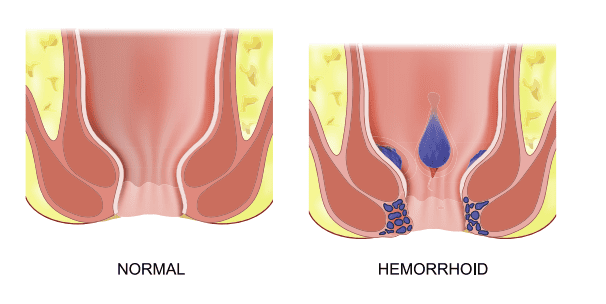
Hemorrhoids are dilated, swollen veins in the rectum and anus that cause discomfort and bleeding. Hemorrhoids can become irritated and enlarged due to straining and constipation and may swell and become in flamed.
Hemorrhoidal disease is the swollen or in flamed state of these vascular structures inside or around the anal canal. It is the most frequent anorectal disease with 5% – 40% occurrence in the population. Hemorrhoids can be located internally at the upper part of the anal canal in the rectum or externally under the skin around the anus.
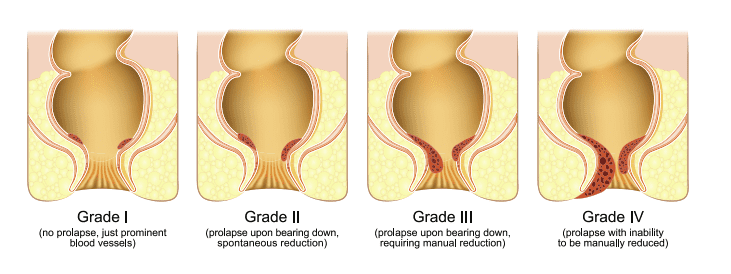
Internal hemorrhoids are more frequent than external hemorrhoids. They are graded by their size and severity from grade one to four. Only internal hemorrhoids are treated using the procedure described in this brochure.
Hemorrhoid Grades
- Grade One – Small swellings on the inside of the lining of the anal canal. No prolapse is present.
- Grade Two – Larger swellings that may prolapse when pushing but recede or reduce naturally.
- Grade Three – Prolapse outside the anus and must be pushed back inside or reduced manually.
- Grade Four – Permanently hang outside the anus and cannot be reduced manually. May cause pain and bleeding.
Typical Symptoms
The most common symptom due to increased blood supply:
- Internal hemorrhoids can become in flamed and traumatized leading to bleeding that is bright red in color.
- Internal hemorrhoids can also cause itching and perineal irritation.
- Hemorrhoidal tissue can lead to soiling by impeding the ability of the anal verge to seal properly.
- External hemorrhoids are typically asymptomatic unless they become thrombosed or in flamed.
- External thrombosed hemorrhoids often cause painful perianal swelling.

How does the Hemorrhoid procedure work?
This minimally invasive procedure, performed by an Interventional Radiologist, is less aggressive than surgical treatment. The embolization procedure is conducted in patients with internal hemorrhoids. The patient receives sedation and local anesthesia to the artery that is accessed. Internal hemorrhoids are composed of a dense arteriovenous network called Corpus Cavernosum Recti (CCR). The embolization of the hemorrhoidal artery aims to reduce the blood flow in the CCR, thus reducing venous pressure and easing symptoms.
- A small opening is made in the groin or wrist using a needle stick, through which a thin catheter is inserted.
- The catheter is guided through the rectal artery tree to the terminal branches while the Interventional Radiologist observes the procedure using medical imaging technology.
- Small coils or particles are then placed into the terminal branches of the arteries to seal the vessels.
- It may be necessary to repeat the embolization for hemorrhoids that have an alternate blood supply, through the same opening and using the same catheter and microcatheter combination.
Hemorrhoidal artery embolization is a painless technique with a procedure time of approximately one hour, after which patients return home the same day.
Frequently Asked Questions
What is Hemorrhoidal Disease?
Hemorrhoids are dilated, swollen veins in the rectum and anus that cause discomfort and bleeding. Hemorrhoids can become irritated and enlarged due to straining and constipation and may swell and become inflamed.
Hemorrhoids can be located internally at the upper part of the anal canal in the rectum or externally under the skin around the anus. Internal Hemorrhoids are more frequent than external Hemorrhoids. They are graded by their size and severity from grade one to four. Only internal Hemorrhoids are treated using the Hemorrhoid embolization procedure.
How does the Hemorrhoid procedure work?
This minimally invasive procedure, performed by an Interventional Radiologist is less aggressive than surgical treatment. The embolization procedure is conducted in patients with internal hemorrhoids. The patient receives sedation and local anesthesia to the artery that is accessed. The embolization of the hemorrhoidal artery aims to reduce the blood flow in the CCR, thus reducing venous pressure and easing symptoms.
Hemorrhoidal artery embolization is a painless technique. The procedure time is approximately one hour. After the procedure, patients return home the same day.
How do I know the Hemorrhoid procedure is right for me?
The embolization treatment is the best option for you if you suffer from internal hemorrhoids of grade 2 or 3 and treatment with hygiene, dietary measures, medication, or non-surgical methods have not been successful. In some cases, grade 4 can be treated. Additionally, if you did not benefit from a surgical treatment, this technique may be the right option for you.
If you’re experiencing symptoms and think you may be suffering from Hemorrhoidal disease, talk with your doctor. This procedure is offered in our Spokane, Tri-Cities, and Missoula locations. To learn more, call Inland Imaging Interventional Radiology Consultants at the location nearest you.
Patient Testimonials
Dr. Jedidiah Schlung, Laura
“Especially to Dr. Schlung and Laura that took excellent care of me during my biopsy.”
Danelle
“She was great! Very good at positioning and explaining what she was doing or going to do and when to breathe. Good guidance through procedure.”
Dan, Paula
“This could have been an extremely uncomfortable appt. Dan and Paula explained everything very well and were very efficient. It was as painless as possible.”